
Woody encroachment isn't a minor nuisance, either. In Nebraska alone, landowners lost an estimated 419,328 tons of annual forage production worth nearly $18 million in 2019 to invasive tree species like eastern redcedar, according to University of Nebraska-Lincoln BeefWatch data. Multiply that across the Great Plains and the stakes get serious fast.
The problem for buyers: dozens of brands call themselves "heavy-duty." Few back it up with construction details or field-proven use. This guide breaks down what actually separates a durable tree shear from a spec sheet, compares the top brands, and explains how shears stack up against pullers and grapples.
Key Takeaways
- Cast steel construction outlasts fabricated steel under repeated shock loads
- Skid steer brand compatibility matters as much as raw cutting force
- Shears, pullers, and grapples solve different problems — pick wrong, waste time
- Real-world use in forestry contracts and government agencies beats any spec sheet
What to Look for When Choosing a Tree Shear Brand
Not every "heavy-duty" shear is built the same way. Here's what separates the ones that hold up from the ones that crack a season in.
Blade and Arm Material
Fabricated steel arms are welded from flat plate and rolled sections. Cast steel arms are poured as a single solid piece, eliminating weld seams that tend to fail under repeated shock loading.
Maxx Attachments' 14-inch Ranch Axe uses solid cast steel shearing arms rated at roughly 60% stronger than comparable fabricated steel designs, a benchmark worth asking any manufacturer to match.
Even within one product line, construction varies by size. The 16-inch Ranch Axe, for example, uses fabricated A572 steel arms instead, built specifically to handle its larger 16-inch cutting capacity. Blade steel matters too: look for AR400 or T1 high-tensile steel on the cutting edges themselves, regardless of arm construction.
Hydraulic Flow and Pressure
A shear is only as strong as the hydraulic system feeding it. Standard auxiliary circuits typically deliver 17-24 GPM at 3,000-3,500 psi, while high-flow setups push 30-42 GPM, according to Mobile Hydraulic Tips. Feeding a low-flow shear from a high-pressure circuit can blow out seals and cylinders.
Maxx's 14-inch and 16-inch Ranch Axe models need a minimum of 15 GPM with shear cylinders rated at 4,000 psi. Match these numbers to your machine's rated output before buying, not after.
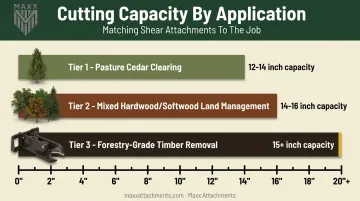
Cutting Capacity vs. Application
Matching cutting capacity to your typical workload keeps the shear from straining on oversized trunks, while avoiding the added cost and weight of capacity you'll rarely use.
- Pasture cedar clearing: 12-14 inch capacity usually covers it
- Mixed hardwood/softwood land management: 14-16 inch capacity gives more headroom
- Forestry-grade timber removal: 15+ inch capacity with dual-blade or bunching features
Most pasture-clearing and land management jobs fall comfortably within the 12-16 inch range Maxx's Ranch Axe lineup covers.
Mounting Compatibility and Warranty Support
Universal mounting plates matter if you run multiple machines or plan to trade equipment later. Confirm compatibility across major brands: Bobcat, Case, Caterpillar, John Deere, Kubota, JCB, Gehl, Manitou, New Holland, and Takeuchi make a reasonable checklist to verify against.
Warranty terms tell you how a manufacturer stands behind its own claims. Maxx Attachments' warranty, governed under Kansas law, requires customers to report defects within 30 days and covers material and workmanship issues under normal use, while excluding damage from misuse or neglected maintenance. That's a useful template for evaluating any brand's fine print.
Top Tree Shear Brands for Skid Steers Compared
Here's how the most-discussed brands in the tree shear market actually compare, based on published specifications rather than sales copy.
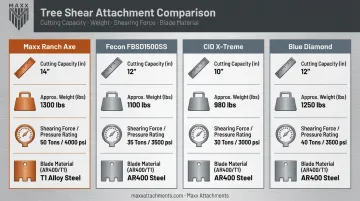
Maxx Attachments (Ranch Axe)
The Ranch Axe line is built around solid cast steel shearing arms on the 14-inch model, delivering that 60% strength advantage over fabricated designs. Maxx states its Ranch Axe shears are deployed on State and US Forest Service sites for fire mitigation and beetle-kill timber removal, real-world proof beyond a catalog claim.
- 14" and 16" models rated for 15 GPM minimum, 4,000 psi cylinder pressure
- Bolt-on replaceable AR400 blades for easy field maintenance
- Universal mount coupler compatible with 10 major OEM brands
- Minimum operating capacity requirement: 1,850 lbs (14"/16" models)
Fecon
Fecon built its reputation in forestry mulching before extending into shears. Its FBSD1500SS model cuts up to 15 inches, runs on 15-23 GPM, and weighs roughly 1,900 lbs with dual AR400 blades, per Fecon's own skid steer attachment brochure. It's positioned for thinning, right-of-way clearing, and fuels reduction work. Pricing isn't published; expect a dealer quote process.
CID Attachments
CID's X-Treme Tree Shear tops out at a 12-inch cutting capacity with a claimed 40 tons of shearing force and a 1-inch AR400 blade. A rotating version adds 90-degree hydraulic or manual rotation. CID markets it as a value-tier option with broad dealer availability, though no published duty-cycle rating exists to compare against premium builds.
Blue Diamond
Blue Diamond's tree shear also caps at 12 inches, rated at 29 tons of force at 2,500 psi, weighing about 1,123 lbs with a 1-inch T1 steel cutting edge. It's a solid mid-tier option, though like CID, published duty-cycle data is thin.
Loftness
Loftness is well known in brush cutting and mulching, but its current skid steer vegetation lineup (the Kwik Fall tree saw and Kwik Cut brush cutter) falls into an adjacent category rather than a dedicated hydraulic tree shear. Worth considering if you need a cutting head, but not a direct shear comparison.
OEM-Branded Options (Bobcat, Cat, John Deere)
This is where buyers often get surprised. Major OEMs don't consistently offer a dedicated vegetation tree shear. Cat's "shears" category, for instance, targets demolition and scrap processing, not tree work.
That leaves aftermarket brands like Maxx, Fecon, CID, and Blue Diamond as the practical choices for purpose-built tree shearing, with the added benefit of cross-brand compatibility if you ever switch host machines.
Tree Shear vs. Tree Puller vs. Grapple: Which Is Right for You?
Picking the wrong tool here doesn't just slow you down — it can double your labor on a job that should've taken half the time.
A tree shear cuts at the base using hydraulic blades or jaws, leaving the stump and root ball in place. It's the fastest option for high-volume selective clearing where regrowth control or replanting isn't an immediate concern. Maxx Attachments builds its Ranch Axe shears specifically for this kind of high-output clearing work.
A tree puller grips the tree and rocks it to loosen and extract the entire root system. This matters when you need the ground clear for construction, grading, or agricultural use, since a stump left behind creates problems for the next piece of equipment that rolls through.
A grapple saw combines grapple jaws with an integrated saw blade, letting one attachment cut, gather, and carry felled material in a single pass. This shines in cleanup phases after shearing, especially when trees need to be sorted or piled for chipping or burning.
Use this simple framework:
- Selective, high-volume cutting → Shear
- Full removal, root and all → Puller
- Bulk handling and sorting after cutting → Grapple (often paired with a shear for maximum efficiency)
Compatibility and Installation Considerations
Getting the right shear on paper doesn't help if it doesn't bolt up and run correctly on your machine.
- Verify hydraulic flow and pressure first. A universal mounting plate confirms fit, not flow — check your auxiliary circuit's GPM and psi against the manufacturer's minimums before ordering.
- Match weight to rated operating capacity. Maxx's 14"/16" Ranch Axe models require a minimum 1,850 lb operating capacity. Undersized machines struggle to lift and maneuver the attachment safely.
- Confirm coupler type. Standard flow flat-face couplings work for most mid-range machines, but high-flow or non-standard circuits may need additional adapters.
- Call before you buy. If your machine's flow exceeds the shear's stated minimum, don't assume it's fine: confirm with the manufacturer to avoid seal or cylinder damage.
Maintenance Tips to Maximize Tree Shear Lifespan
A shear that's maintained well outlasts one that isn't, regardless of brand. A few habits go a long way:
- Inspect blades regularly. Bolt-on AR400 blades are designed for easy field replacement — check them for chips, dulling, or excessive wear before each heavy use cycle.
- Check hydraulic hoses and pins routinely. Guarded hard lines reduce hose wear, but pins, bearings, and cylinder seals still need periodic inspection to catch small leaks early.
- Store properly in the off-season. Clean, lubricate, and coat exposed cylinder rods before storage to prevent rust buildup over winter months.
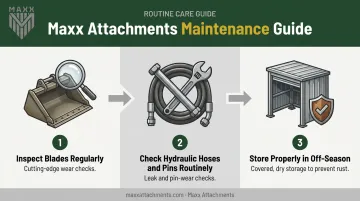
None of this replaces your specific model's owner's manual, but these three habits catch most of the wear issues that shorten a shear's working life.
Frequently Asked Questions
What is the best skid steer tree shear on the market?
The "best" shear depends on your cutting capacity needs and duty cycle. Cast-steel-arm designs like the Ranch Axe deliver roughly 60% more strength than fabricated-steel arms, setting a strong durability benchmark, but forestry-grade jobs may call for a higher-capacity option like Fecon.
Is a skid steer tree puller better than a tree shear?
Pullers win when you need full root removal for construction or replanting; shears win for fast, high-volume selective cutting. The better choice depends entirely on your clearing goal.
What is the best skid steer grapple for tree work?
It depends on log size and volume you're handling. Pairing a grapple saw with a shear often speeds up overall clearing by handling cutting and cleanup in separate, efficient passes.
How much does a skid steer tree shear cost?
Pricing varies by cutting capacity, build material, and brand, with most manufacturers quoting based on your specific machine and application. Contact Maxx Attachments directly for an accurate quote tailored to your setup.
Can a tree shear attachment fit any skid steer brand?
Most modern shears use universal mounting plates that fit 10+ major OEM brands, including Bobcat, Case, and John Deere. Always verify hydraulic flow and pressure compatibility first, since mounting fit doesn't guarantee hydraulic performance.
What size trees can a skid steer tree shear cut?
Cutting capacity typically ranges from 12 to 20 inches depending on the model, with pasture cedar work needing less capacity than mixed hardwood or forestry-grade clearing. Match capacity to your actual vegetation, not just your biggest tree.