
This gap matters because the stakes are real. Universal quick-attach couplers let you physically connect almost any attachment to almost any skid steer, but that connection alone doesn't guarantee the weight, hydraulic flow, and pressure actually match. When they don't, the result can be poor performance, attachment damage, or downtime.
This guide walks through what to prep before the demo, what to physically test once you're in the cab, red flags that should stop a purchase, and the questions worth asking before you sign anything.
Key Takeaways
- A test drive reveals real-world cutting power and durability no catalog can show.
- Confirm hydraulic flow, lift capacity, and mount fit before scheduling your demo.
- Stalling, vibration, and deck scalping during testing signal costly problems ahead.
- Ask about warranty and parts support to protect your investment long-term.
Why You Should Never Buy a Brush Cutter Without a Test Drive
Cut width, motor displacement, and horsepower are ingredients. They tell you what the machine is built with, not how it behaves once it's chewing through actual brush.
Two cutters with nearly identical spec sheets can perform completely differently under sustained load, depending on how the motor, pump, and deck are actually engineered to work together.
The financial exposure backs this up. Heavy-duty skid steer rotary brush cutters commonly list in the $10,000 to $23,000+ range depending on width and configuration, based on one 2025 manufacturer price schedule. That's a serious capital commitment for equipment you might use for a decade or more.
A test drive costs you an hour, maybe two. Compare that to:
- Discovering the motor stalls out on your typical brush after you've already paid
- Finding out the deck gouges every uneven pasture you own
- Realizing the hydraulic flow doesn't match and you're stuck troubleshooting overheating issues
A test drive is the cheapest insurance policy you'll buy on a five-figure attachment. Skip it, and you're betting thousands of dollars on a printed spec sheet instead of watching the machine actually cut.
Before You Schedule the Demo: Matching Your Skid Steer to the Brush Cutter
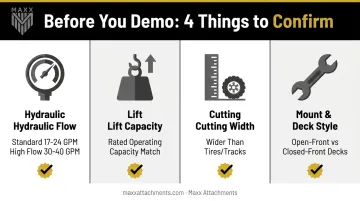
Walking into a demo without knowing your own machine's numbers wastes everyone's time. Get these four things confirmed first.
Hydraulic Flow: Standard vs. High Flow
Every brush cutter motor has a minimum and maximum GPM it can accept. Feed it too little and it underperforms; push too much through it and you risk overheating the motor or blowing a seal. CASE Construction defines standard flow as roughly 17-24 GPM at around 3,000-3,500 psi, while high flow runs 30-40 GPM on the same platforms.
Running a cutter outside its rated flow range doesn't just hurt performance. It can void the manufacturer's warranty outright.
Lift Capacity and Cutting Width
Two more numbers to check before you leave the shop:
- Rated operating capacity: your skid steer needs enough lift capacity to safely carry the attachment's full weight, since an oversized cutter on an undersized machine creates leverage problems and tips stability the wrong way.
- Cutting width: the deck should be wider than your tires or tracks so you're not grinding uncut brush into them, but going too wide adds weight and power demand the machine may not feed.
Mount Compatibility and Deck Style
Confirm the quick-attach plate matches your skid steer brand (Bobcat, Caterpillar, John Deere, Kubota, or whichever you run) before the demo is even scheduled. Also decide which deck style you actually need:
- Open-front decks cut material before it reaches the deck itself, which helps with faster cleanout on heavier brush and saplings.
- Closed-front decks suit lighter grass and maintenance mowing where containment matters more than throughput.
Once those boxes are checked, ask the dealer to demo the cutter on material close to your actual job site, such as grass, saplings, or brush near the machine's rated maximum diameter, instead of a manicured showroom lawn that tells you nothing.
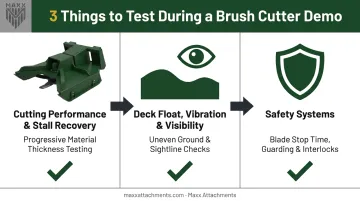
What to Physically Test During the Brush Cutter Demo
This is where the spec sheet stops mattering and observation takes over.
Cutting Performance and Stall Recovery
Start in light grass, then move progressively into thicker material up to the cutter's rated maximum diameter. Watch closely:
- Does it slice cleanly, or does it hesitate and bog down?
- When it hits dense material at full operating RPM, how fast does it recover speed?
- Does the same hesitation repeat, or was it a one-off?
Piston-driven hydraulic motors generally offer stronger high-pressure and efficiency capability than gear or vane motors under sustained heavy load, though gear motors remain simpler and less expensive to maintain. Either can work well — what matters is whether the specific unit in front of you actually recovers quickly after a stall, not just what type of motor is inside it.
Deck Float, Vibration, and Visibility
Drive the cutter over uneven ground, mounds, and ruts. A deck that gouges or scalps signals weak bracing or no floating capability for rough terrain. If it does float, try locking it into a fixed position on soft ground to see how that adjustment feels from the cab.
While you're at it:
- Listen and feel: unusual vibration transmitted into the cab or abnormal noise usually points to an unbalanced flywheel, a worn bearing, or loose blade hardware.
- Check sightlines: can you actually see the cutting edge, and do the joystick controls let you adjust deck height smoothly on the fly?
- Test the float evenly: run the deck across a crown or ditch and confirm both sides settle at the same rate, not just one corner.
Safety Systems
Before you climb out of the cab, verify the hydraulic system stops blade rotation quickly once flow is cut. Check that guarding, lift limit chains, and cab door protection meet your expectations, and confirm the seat belt interlock and emergency stop function on every cycle, not just the first one. These features stand between you and a serious incident on uneven ground.
Red Flags to Watch For During the Test Drive
Certain warning signs should make you pause before signing anything, regardless of how good the price looks:
- Excessive vibration or rattling — often traces back to an unbalanced flywheel, a worn spindle bearing, or loose blade retention hardware.
- Frequent bogging or stalling on moderate material usually points to an underpowered motor or a flow mismatch between the cutter and your skid steer's actual hydraulic output.
- Deck gouging or scalping on uneven ground suggests weak bracing or the absence of a floating deck suited to your terrain.
None of these are minor annoyances you'll "get used to." They're symptoms of a mismatch that will only get worse with hours on the clock.
Smart Questions to Ask the Dealer Before You Buy
The demo tells you how the machine performs today. These questions tell you what happens after the sale.
- What exactly does the warranty cover on the spindle, motor, and blade carrier, and how are claims actually processed if something fails?
- How available are wear parts like blades and skid shoes, and what's the typical turnaround time when you need one?
- Can you provide real-world references — government, forestry, or agricultural accounts running the same model in conditions similar to yours?
A dealer who answers these clearly and specifically, rather than vaguely, is usually a good sign of how they'll handle you after the invoice is paid.
Why Maxx Attachments Brush Cutters Are Built to Pass Every Test Drive
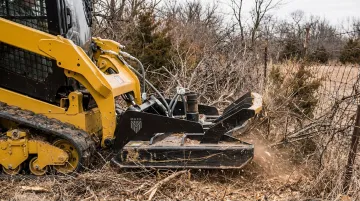
Maxx Attachments' Vortex Brushcutter is built around exactly the kind of load test described above. Its extreme-duty gear motor is backed by a 750-pound heavy-duty flywheel, engineered to maintain consistent power on material up to 6 inches in diameter without bogging down. That flywheel stores rotational energy, carrying the blades through dense brush instead of stalling out.
The open-face deck design cuts material before it reaches the deck itself, which speeds up cleanout and keeps debris from building up mid-job. Four replaceable AR400 cutting knives keep cutting resistance low, so the motor isn't fighting dull steel on top of everything else.
Maxx's broader tree-cutting and land-clearing lineup follows the same standard. Its cast steel Ranch Axe shears, built 60% stronger than fabricated steel alternatives, have seen field use on US Forest Service sites for fire mitigation and beetle-kill timber removal. That's the kind of sustained, heavy-duty conditions a good demo is designed to simulate.
Matching the Vortex Brushcutter to your skid steer's hydraulic output is straightforward thanks to its range of configurations:
- Cutting widths: 70-inch and 80-inch options
- Flow configurations: Standard, medium, and high-flow (19-41 GPM)
- Brand compatibility: Works across 10 major skid steer brands
- Warranty support: Backed by Kansas law with a defined claims process
Reach out to schedule a side-by-side test drive and see how it performs on your own material.
Frequently Asked Questions
Who makes the best brush cutter for a skid steer?
"Best" depends on matching motor type, deck style, and build quality to your material and duty cycle. Look for manufacturers offering extreme-duty gear motors and reinforced deck construction, then compare those build details side-by-side during your test drive.
What size skid steer do I need to run a brush cutter?
Cutting width, hydraulic flow (GPM), and lift capacity together determine which skid steer class works. Small frames typically run under 50 hp with lower rated operating capacity, while medium and large frames offer more power and flow for wider decks.
What should I look for during a brush cutter demo?
Check cutting performance under progressively thicker material, hydraulic stall recovery speed, vibration or noise, deck behavior on uneven ground, and how quickly the blades stop once hydraulic flow is cut.
Can I test drive a brush cutter before buying it?
Most dealers offer demos on request. Bring your own skid steer if possible, or ask for job-site material similar to yours rather than accepting a generic showroom lawn test.
What hydraulic flow rate do I need for a skid steer brush cutter?
Standard flow runs roughly 17-24 GPM, while high flow runs 30-40 GPM on most platforms. Match your skid steer's actual output to the cutter motor's rated range, not just the flow "label."
How do I know if a brush cutter is durable enough for heavy brush?
Look for solid steel blade carriers, reinforced deck bracing, and a heavy flywheel for stall resistance. Real-world proof points, like fire mitigation or forestry service use, are a strong indicator of field-tested durability.