
Here's the problem: photos and spec sheets can't show you real cutting performance. A PDF might list a 14-inch capacity, but it won't tell you if that cut takes one clean pass or three grinding attempts. That's why buyers increasingly want to see the attachment working before they commit.
This guide breaks down what a tree shear actually is, how to evaluate demo footage with a critical eye, and what models like the Ranch Axe and Timberwolf from Maxx Attachments show in real-world use.
Key Takeaways
- Cutting capacity ranges from small brush to 14- or 16-inch trunks
- GPM and PSI, not just jaw size, determine cycle speed and cutting force
- Cast steel arms resist bending and fatigue better than fabricated arms
- Single-tree and accumulator-arm shears serve different production goals
- Demo footage should disclose hydraulic setup, wood species, and cut type
What Is a Skid Steer Tree Shear and How Does It Work?
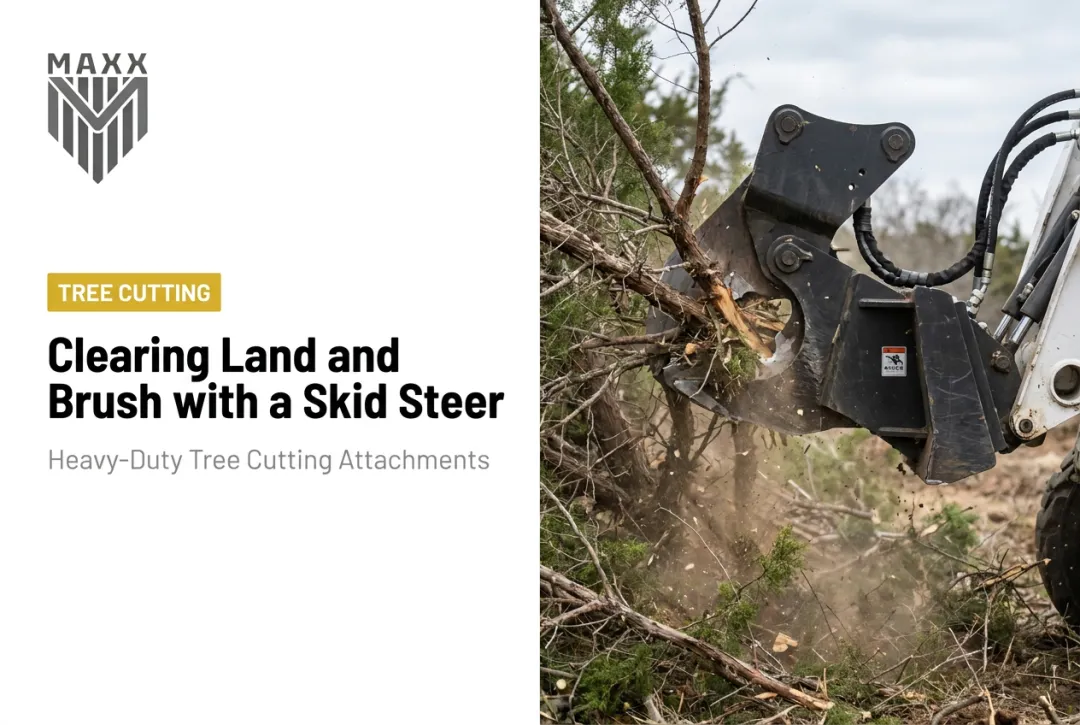
A skid steer tree shear is a hydraulically powered jaw or blade tool that mounts to a skid steer's quick-attach plate. The operator drives up to a tree, closes the jaws around the base, and severs the trunk in one motion rather than felling it with a chainsaw.
The mechanism is straightforward: a hydraulic cylinder drives a moving blade against a fixed jaw, shearing through the trunk under pressure. No chain, no kickback from a spinning blade, just controlled force applied at ground level.
Cutting capacity varies by model. Maxx Attachments' Ranch Axe line, for instance, comes in 14-inch and 16-inch configurations, with the maximum cutting diameter matching the model name directly.
Published capacities elsewhere in the industry span roughly 8 to 16 inches, with at least one manufacturer's 8-inch shear rated to cut an 8-inch tree in a single bite, according to a Grace Manufacturing product flyer. That's a useful benchmark, not a universal standard, so always check the specific model you're considering.
Common use cases include:
- Clearing invasive cedars and junipers choking out pastureland
- Right-of-way clearing along fence lines, roads, and utility corridors
- Fire mitigation thinning in dense forest stands
- Removing beetle-kill timber before it becomes a wildfire hazard
Tree Shear vs. Brush Cutter vs. Mulcher
These three attachments look similar in videos but do very different jobs. A tree shear makes a single cut through an individual trunk. A brush cutter uses a rotary deck with spinning blades to mow through dense brush and smaller vegetation, similar to an oversized bush hog. A mulcher grinds trees and underbrush into mulch using a rotating drum fitted with teeth.
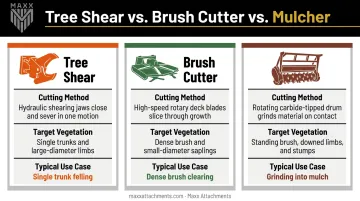
A brush-cutter attachment illustrates the category well. It handles vegetation up to 6-8 inches in diameter across 70-inch or 80-inch cutting widths, running on 19 to 41 GPM of hydraulic flow. It's built for clearing thick brush fast, not felling individual mature trees, which is exactly the job a shear is designed for.
Why Watching a Tree Shear Video Matters Before You Buy
A spec sheet tells you the rated diameter. It won't tell you how long the jaws take to close, whether the machine struggles on a leaning trunk, or how it handles a multi-stem cedar clump. Video footage fills in those gaps.
Cycle time is the big one. Watch how long it takes from jaw open to jaw closed on a tree near the rated capacity. A shear that labors through a cut at max diameter is telling you something about its power margin.
Footage also exposes hydraulic reality. Every shear has a minimum flow requirement, and running one on a skid steer that can't supply enough GPM leads to sluggish, underpowered cuts.
Underpowered attachments can also strain seals and cylinders over time, according to Green Industry Pros' equipment matching guide. If a demo doesn't disclose the host machine's flow output, that's a red flag, not a small omission.
Finally, terrain matters. A shear that looks smooth on dry, flat pasture ground might behave differently on wet forest floor or snow-covered slopes. Look for footage across varied conditions before assuming stability will match your property.
What to Look for in a Skid Steer Tree Shear Demo Video
Demo footage ranges widely in usefulness. Here's what separates a useful video from a highlight reel.
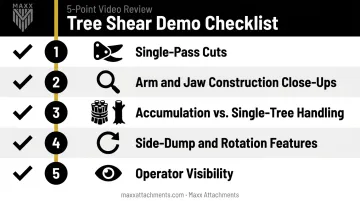
- Single-pass cuts. A clean cut in one motion signals adequate hydraulic power and blade sharpness; multiple attempts on the same trunk suggest an underpowered machine or a blade that needs replacing.
- Close-up shots of arm and jaw construction. Solid cast steel arms and welded fabricated arms behave differently under repeated stress, so footage that lingers on construction details gives you more to evaluate than wide shots of trees falling.
- Accumulation versus single-tree handling. Some shears grab and hold multiple small stems before cutting; others fell one tree at a time. Match the footage to your actual clearing volume.
- Side-dump or rotation features. Some attachments include rotating heads for maneuvering in tight spaces, but not every shear has this — don't assume it unless the video or spec sheet confirms it.
- Operator visibility and control ease. Watch the cab shots to see if the operator can view the jaws clearly during the cut. Awkward positioning slows production and raises safety concerns on a busy site.
Maxx Attachments Tree Shears in Action: Ranch Axe and Timberwolf
Maxx Attachments builds two distinct tree shear lines, and knowing the difference helps you know what to look for in footage of each.
The Ranch Axe: Built for Single-Tree Felling
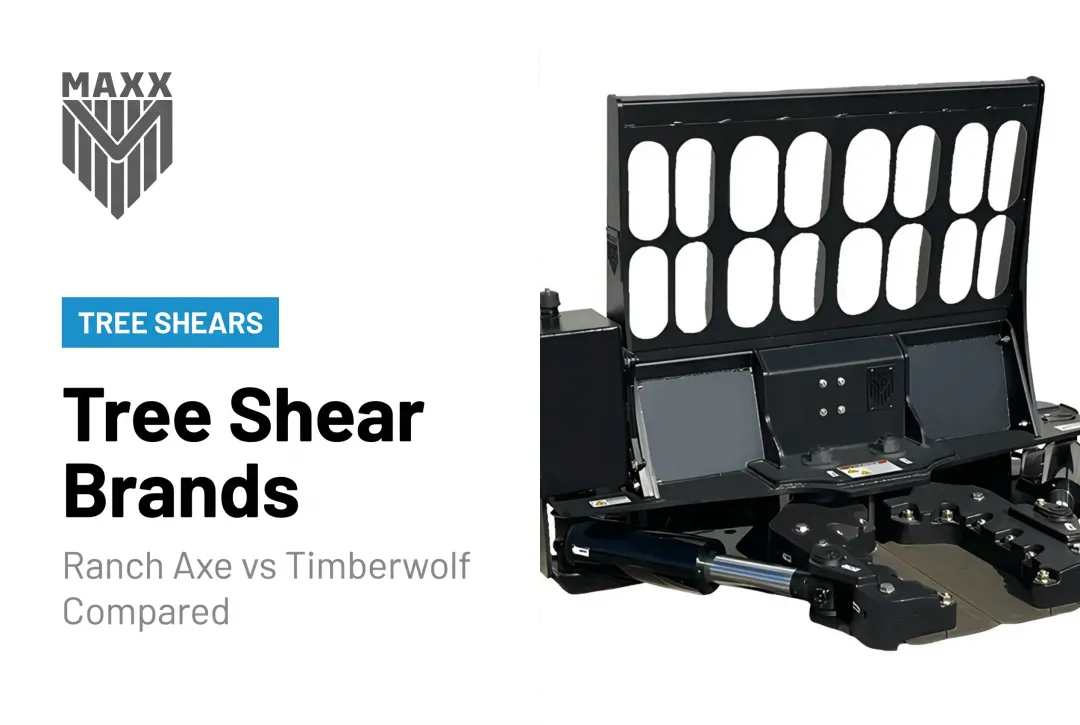
The Ranch Axe (14-inch and 16-inch models) is built for general land clearing: pasture cedar removal, hardwood shearing, and right-of-way work.
Specs vary by size:
- 14-inch models: Solid cast steel shearing arms, stated by the company to deliver 60% stronger performance than comparable fabricated steel arms
- 16-inch model: Fabricated A572 steel arms, sized up to handle its larger cutting diameter
- All models: 3/4-inch AR400 bolt-on replaceable knife edge, built to hold up under repeated high-impact cutting
The Ranch Axe is a single-tree felling tool. If you're watching demo footage and expecting to see it grab a cluster of small stems at once, you won't find that here; that capability belongs to a different product line.
The Timberwolf: Built for Forestry Production
The Timberwolf is that other line. Built specifically for professional forestry work, it adds dual grapple arms and an accumulator arm that lets the operator shear one tree while holding it, then move to the next stem without stopping. Maxx Attachments markets it with a 33% faster shear speed than earlier designs.
Maxx Attachments states both lines are actively deployed on State and US Forest Service sites for fire mitigation and beetle-kill timber removal. The company also makes a Hi-Performance Tree Saw that delivers 40% more cutting torque than comparable products. If cutting speed is a priority for your operation, it's worth confirming that claim in footage.
If you have specific terrain or tree diameters in mind, it's worth contacting Maxx Attachments directly to ask about footage or specs that match your conditions most closely.
How to Choose the Right Tree Shear for Your Skid Steer
Picking the right shear comes down to three checks: hydraulics, coupling, and use case.
Match hydraulic flow first. The Ranch Axe requires a minimum of 15 GPM with a shearing cylinder rated at 4,000 PSI. Running below this minimum leads to slow, weak cuts, while exceeding the rated pressure risks premature wear on the cylinder seals.
Confirm quick-attach compatibility. Most tree shears use a universal mounting plate, but always verify fitment against your specific machine. Maxx Attachments' lineup is built to work across:
- Bobcat
- Case Construction
- Caterpillar
- John Deere
- Kubota
- JCB
- Gehl
- Manitou
- New Holland
- Takeuchi
Match the shear to your actual job. Clearing scattered cedar from 40 acres of pasture is a different job than felling beetle-kill pine across a forest stand. The 14-inch Ranch Axe handles lighter, scattered growth with faster cycle times, while the 16-inch model tackles larger-diameter timber and heavier production work.
Safety Considerations Highlighted in Tree Shear Videos
The best demo footage shows a controlled, safe operation from start to finish, not just a clean cut.
Watch for proper operator positioning and clear cab visibility during the cut. Tree shears can produce less predictable fall direction than a chainsaw felling cut, so the operator needs a full view of the tree's lean before closing the jaws.
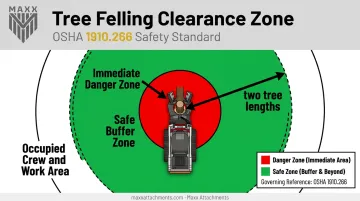
Pay attention to clearance zones in the footage. OSHA's logging standard calls for two tree lengths of separation between an active felling operation and any occupied work area, per OSHA's 29 CFR 1910.266 standard. It's a useful benchmark even outside formal logging operations. If a video shows bystanders or equipment inside that zone during a cut, treat it as a red flag rather than a minor detail.
Finally, review the manufacturer's specifications alongside the footage. Confirmed cutting diameter and hydraulic flow requirements determine whether a shear can safely handle the tree sizes shown on screen. Always verify these specs match your skid steer's rated capacity before treating any video as a buying guide.
Frequently Asked Questions
What size tree can a skid steer tree shear cut?
Cutting capacity varies by model, ranging from small brush up to 14-inch or 16-inch trunks for models like the Ranch Axe. Always check the manufacturer's spec sheet for the exact rating on the model you're considering.
How much hydraulic flow do I need to run a tree shear attachment?
Flow requirements vary by shear size; the Ranch Axe needs a minimum of 15 GPM, for example. Match your skid steer's rated GPM and PSI output to the attachment's spec sheet before buying.
Can a tree shear be mounted on any skid steer brand?
Most tree shears use a universal quick-attach plate compatible with major brands including Bobcat, Caterpillar, John Deere, and Kubota. Still, verify fitment and hydraulic compatibility before finalizing a purchase.
What is the difference between a tree shear and a brush cutter?
A tree shear makes a single hydraulic cut through an individual trunk, ideal for larger trees. A brush cutter uses a rotary blade deck designed for dense brush and smaller vegetation, not mature trees.
How much does a skid steer tree shear attachment cost?
Pricing varies based on cutting capacity, arm construction, and brand. Maxx Attachments, for example, quotes pricing on request instead of listing fixed prices. Contact us directly for current figures.
Are skid steer tree shears safe to use on slopes or uneven terrain?
Operating on slopes requires extra caution since a shifting center of gravity increases tip-over risk. Follow manufacturer guidelines, keep ground speed low, and avoid working across a slope with a raised load.