
A skid steer paired with a brush cutter, mulcher, or tree shear turns a multi-day clearing job into an afternoon task. But results vary widely. Machine size, hydraulic flow, attachment choice, and operator technique all determine whether you finish on schedule or spend the day fighting a bogged-down cutter head.
This guide walks through the full process: prep steps, performance factors, common mistakes, and troubleshooting tips for clearing land and brush with a skid steer.
Key Takeaways
- Skid steers efficiently clear brush and trees up to 6 inches in diameter
- Larger stems or dense timber require higher-flow machines or dedicated forestry attachments
- Matching the attachment to vegetation density matters more than machine size alone
- Hydraulic flow rate and horsepower determine which attachments you can run
- A survey-clear-cleanup sequence prevents most costly mistakes on a clearing job
How to Clear Land and Brush with a Skid Steer
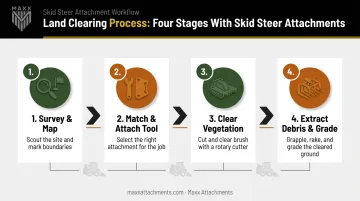
Step 1: Survey the Site and Map Your Clearing Path
Walk the entire property before you start the engine. Flag hazards such as buried utilities, large rocks, stumps, fence lines, and property boundaries.
Before any ground-disturbing work, call 811 to have utility lines located and marked. Skipping this step is one of the fastest ways to turn a routine clearing job into an expensive repair bill.
Once hazards are flagged, decide on a clearing sequence. Working perimeter-in clears the outer edges first and moves toward the center, while cutting a path to the back of the lot first keeps the machine from getting boxed in.
Check ground conditions, too. Soft or wet soil calls for tracked configurations; firm, dry ground works fine with wheels.
Step 2: Match and Attach the Right Tool for the Vegetation
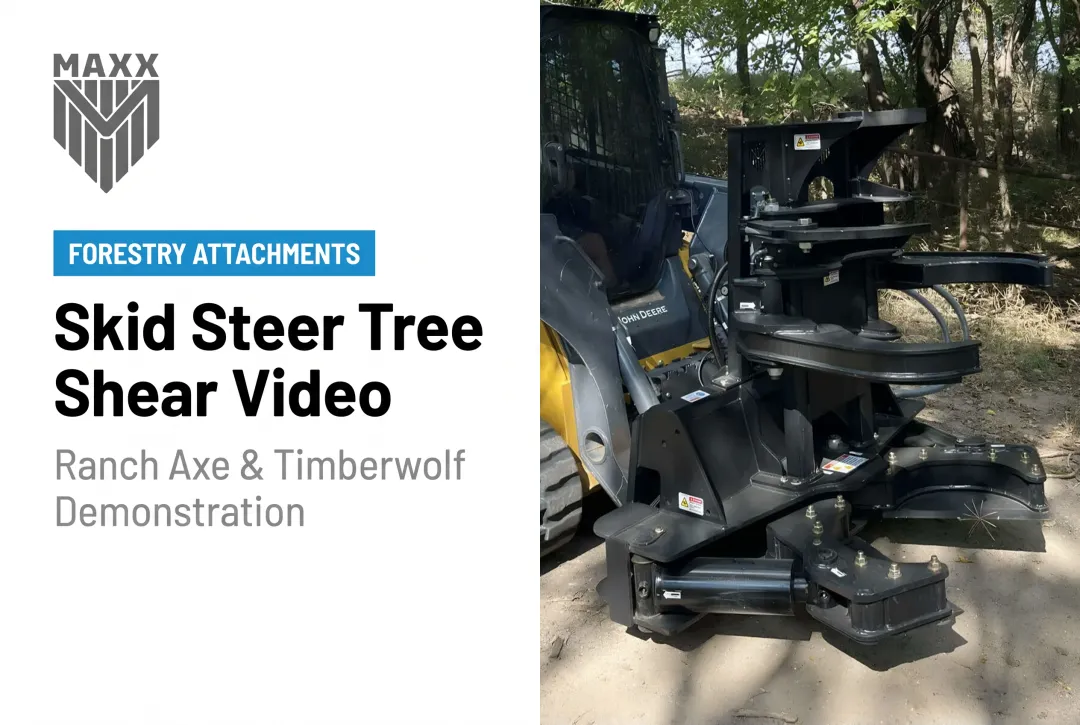
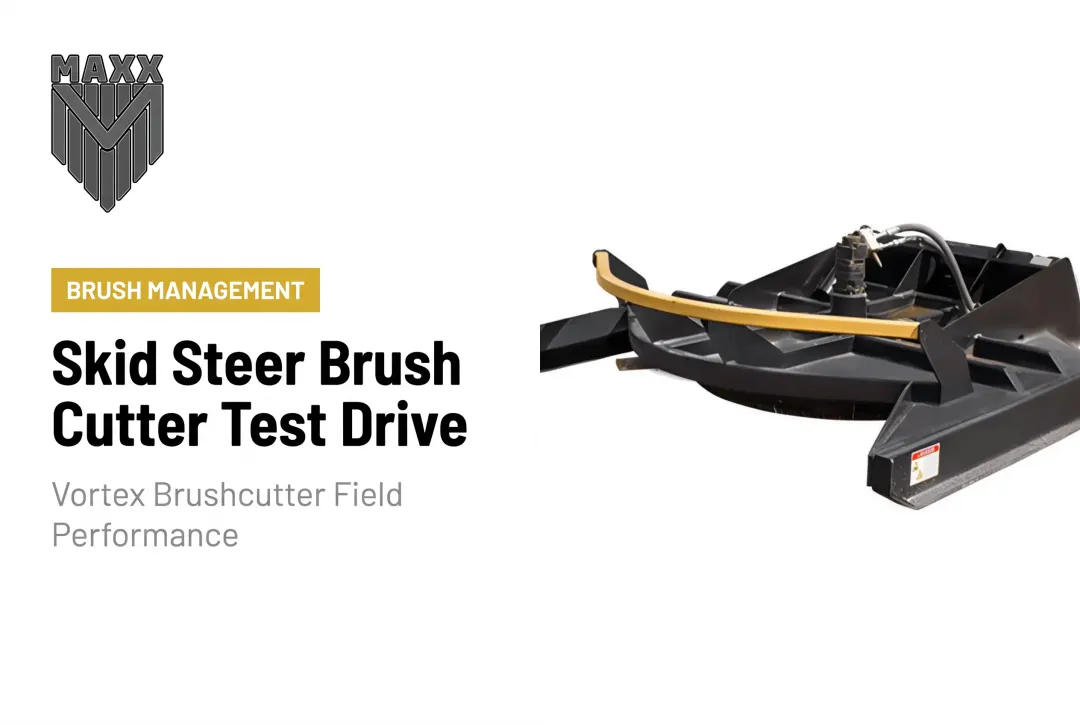
Vegetation type drives attachment choice. Grass, shrubs, and saplings call for a brush cutter. Dense woody growth needs a mulcher. Standing trees over several inches in diameter require a tree shear or saw.
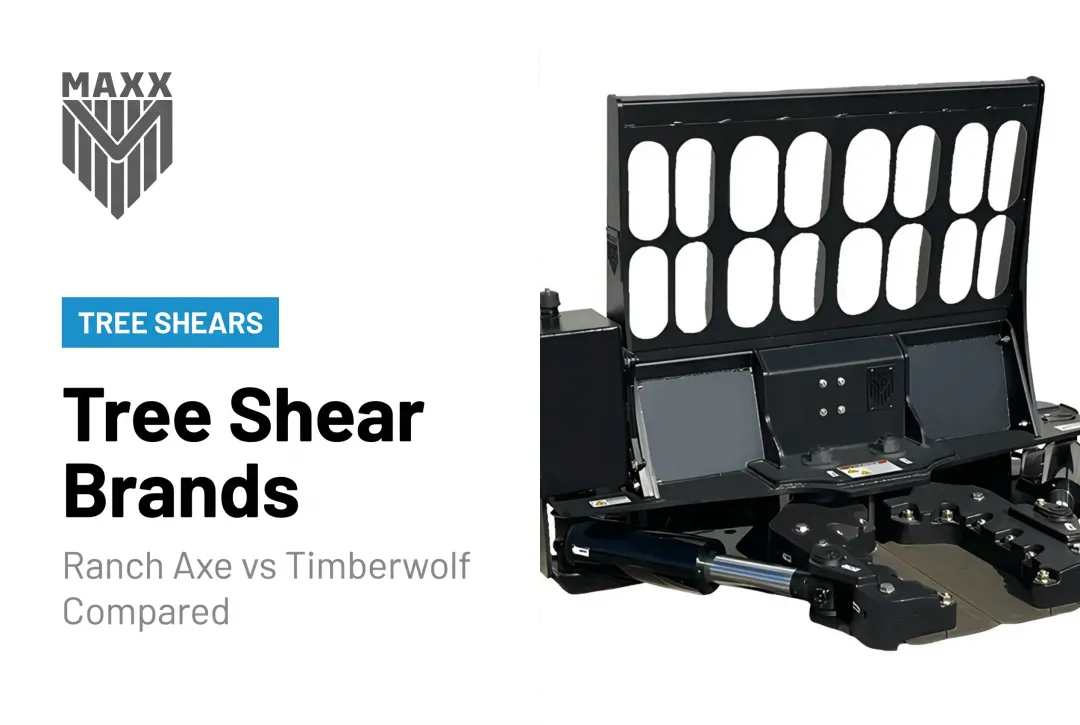
For standing timber, Maxx Attachments' 14-inch and 16-inch Ranch Axe tree shears need a minimum of 15 GPM and 1,850 lbs of rated operating capacity, with solid cast-steel arms built to handle the load.
Before connecting anything:
- Confirm the attachment's flow requirement matches your skid steer's rated output
- Engage the quick-attach coupler and lock it securely
- Connect auxiliary hydraulic lines
- Inspect hoses, pins, and mounting hardware for wear or damage
Step 3: Clear the Vegetation Methodically
Work at a steady, controlled pace. Lower the cutter head into brush or feed it into standing trees rather than forcing the machine through material it isn't rated for.
Keep a clear debris-throw zone. Rotary cutters and mulchers can eject material well beyond arm's reach, and bystanders should stay clear of the entire work area, not just the immediate vicinity.
A few habits improve both safety and results:
- Keep skid paths as straight as possible to reduce tire and track wear
- Avoid sudden direction changes while the attachment is engaged
- Watch engine RPM and hydraulic gauges for signs of strain
Step 4: Extract Debris, Grade, and Finish the Site
Once vegetation is down, switch tools. A grapple bucket picks up logs, brush piles, and larger debris far more effectively than a standard bucket, since it clamps irregular material instead of letting it roll out.
From there:
- Use a loader rake or grading attachment to smooth ruts and skid marks
- Pile debris at a staging or burn area
- Walk the site one final time to check for stumps, roots, or hazards left below grade
A finished site should be walkable without surprises. Missed stumps or roots below grade can damage mowers, tillage equipment, or vehicles that use the site later.
When Should You Clear Land With a Skid Steer?
Skid steers excel on pastures, fence lines, building pads, and properties with brush and trees generally under 6 inches in diameter. Dense mature forest, large-diameter timber, or multi-acre commercial clearing jobs usually favor high-flow forestry mulchers, track dozers, or feller bunchers instead.
Scale matters, though experts disagree on the exact cutoff.
"Skid steer attachments become noticeably less productive than dedicated mulchers once a project passes roughly 4 acres," says John Tucker of Gyro-Trac, in an interview with For Construction Pros.
Other equipment specialists favor compact carriers for underbrush work on sites up to 5 acres, citing mobility as the deciding factor.
Rough guidance:
- Under 5 acres: A well-matched skid steer and attachment combo is typically the more practical choice
- 5 to 20+ acres: Larger, higher-flow skid steers or supplemental heavy equipment often make more sense
- Dense, continuous forest: Dedicated forestry mulchers or track dozers outperform attachment-equipped carriers on raw production speed
The right call depends less on acreage alone and more on stem density, terrain, and how often the machine needs to move between sites.
What You Need Before Clearing Land With a Skid Steer
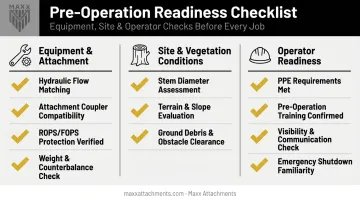
Under-matching the machine to the job is the single biggest cause of poor clearing results. Getting three things right up front, equipment, site conditions, and operator readiness, prevents most problems before they start.
Equipment & Attachment Requirements
Confirm hydraulic flow and pressure before you attach anything. Standard-flow skid steers typically deliver 17.6 to 23.6 GPM, while high-flow systems run 26.9 to 36.6 GPM, according to Bobcat's hydraulic matching guidance. Running an attachment below its rated flow causes bogging and premature wear; exceeding the rated pressure can damage seals and motors.
Heavy-duty attachments are built for this demanding work. The Ranch Axe shears use solid cast steel arms rated 60% stronger than fabricated steel competitors, shearing stems cleanly in a single pass. All Maxx Attachments products are engineered for compatibility across 10+ major OEM brands, including Bobcat, Case, Caterpillar, John Deere, and Kubota.
Site & Vegetation Conditions
Before committing to a machine, assess:
- Stem diameter and density across the site, not just at the entry point
- Ground firmness, since soft or sloped terrain changes both attachment choice and machine configuration
- Species mix, since some shears (like the 16-inch Ranch Axe) are built for softwoods such as cedar and juniper, while hardwoods like mesquite and oak call for the 14-inch model instead
Operator Readiness
The operator needs proper protection and training before the engine starts. OSHA's site clearing standard requires rollover protective structures with at least 1/8-inch steel plate or equivalent overhead guarding for equipment used in this kind of work.
Before starting:
- Confirm ROPS/FOPS cab protection is intact
- Wear appropriate PPE, including eye and hearing protection
- Know the location of the emergency hydraulic shutoff
- Understand how to reset the attachment if it trips a safety stop
Key Factors That Affect Land Clearing Results
Outcomes hinge on a handful of controllable variables, not raw machine size alone.
Skid Steer Size & Horsepower
Larger frame sizes and higher rated operating capacity support heavier attachments and longer duty cycles. Undersized machines stall or overheat when pushed into dense brush. Oversized machines, on the other hand, lose maneuverability in tight areas like fence corners or building pads.
Hydraulic Flow Rate
Attachments like mulchers and brushcutters need a minimum GPM to spin their cutting heads at full power. Insufficient flow causes bogging, slow cutting speed, and accelerated wear on the attachment's motor. Match both flow and pressure to the manufacturer's specification, not just a general "high flow" label.
Attachment-to-Vegetation Match
Brush cutters, mulchers, and shears are built for different stem densities and diameters. Using the wrong tool, a light-duty brush cutter on mature trees, for example, reduces efficiency and risks real equipment damage. This is precisely why Maxx Attachments builds dedicated shear models, like the 14-inch and 16-inch Ranch Axe, sized for different trunk diameters instead of forcing one head to handle every job.
Operator Technique and Load Balance
A commonly repeated "70/30 rule" claims operators should keep attachment engagement within 70% of rated capacity. That's a misreading of the actual data.
Bobcat's own weight-distribution figures tell a different story:
- Unloaded skid steer: about 70% of weight on the rear axle, 30% on the front
- Rated load: weight shifts closer to 30% rear, 70% front
It's a balance principle, not an engagement limit.
The practical takeaway still holds: don't force an attachment beyond what the manual specifies. Ignoring rated limits increases tip-over risk and accelerates wear on tires, tracks, and hydraulics.
Common Mistakes and Troubleshooting Tips
Most clearing problems trace back to a handful of repeatable errors.
Common mistakes:
- Skipping the site survey, which leads to hitting hidden stumps, rocks, or utility lines mid-job
- Mismatching the attachment to vegetation density, causing stalling or excessive wear
- Working without a spotter on large or overgrown sites, reducing awareness of hazards and debris throw
Troubleshooting on the job:
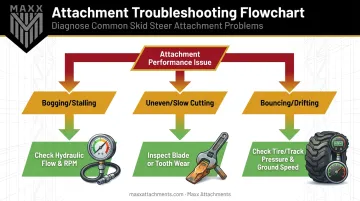
- If the attachment bogs down or stalls, check hydraulic flow settings and engine RPM before assuming attachment failure
- If cutting quality turns uneven or slow, inspect blade or tooth wear and confirm the attachment is rated for the material being cleared
- If the machine bounces or drifts on uneven ground, check tire or track pressure and adjust ground speed before blaming the attachment
A five-minute check often saves an hour of frustration. Most "attachment failures" are actually flow, pressure, or wear issues that a quick inspection catches immediately.
Frequently Asked Questions
Land clearing with a skid steer works well when the machine, attachment, and technique all match the job. Most failures trace back to skipped prep or mismatched equipment, not the machine itself.
What size skid steer is best for land clearing?
The right size depends on the attachment's rated requirements, not a fixed weight class. Match your skid steer's operating capacity and hydraulic flow to the specific attachment manual, since requirements vary significantly between models.
What is the best heavy equipment for land clearing?
Skid steers are the most versatile, cost-effective choice for small-to-mid scale clearing. Dense forest or large commercial tracts often call for forestry mulchers or feller bunchers instead.
What is the 70/30 rule for skid steers?
It actually refers to weight distribution: an unloaded skid steer carries about 70% of its weight on the rear axle, shifting to roughly 70% front once loaded. It's not a rule about engaging an attachment at 70% of rated capacity.
Can any skid steer clear brush and small trees?
Most skid steers can run a basic brush cutter. Denser brush and trees over a few inches in diameter require higher horsepower and hydraulic flow, so check the attachment's minimum GPM rating first.
Do you need high-flow hydraulics to clear land with a skid steer?
Standard flow works fine for light brush cutting. Mulchers, forestry shears, and heavy-duty brushcutters generally need high-flow hydraulics to perform at full capacity.
How thick of trees can a skid steer brush cutter cut?
Most heavy-duty brush cutters are rated to cut brush and trees up to about 6 to 8 inches in diameter, depending on species and density.