
Introduction
Many equipment orders treat bucket size as an afterthought. It shouldn't be. The bucket determines how much material moves per pass, how hard the hydraulics and drivetrain work, and whether the machine stays upright on uneven ground.
Many buyers confuse "bucket size" with width, loader class, or horsepower — they're related, but not the same thing. A bucket rated for one machine's tipping load can be dangerously oversized on another, even if it physically bolts on.
This article breaks down what bucket capacity actually measures and how sizes vary, from under 1 cubic yard on compact machines to more than 20 cubic yards on mining-class loaders. It also covers what factors should drive your selection and what happens when the size is wrong.
Key Takeaways
- Bucket capacity spans under 1 cubic yard on compact loaders to 50+ cubic yards on mining-class rigs
- Selection depends on horsepower, tipping load, and material density, not just visual fit
- Heaped capacity, not struck capacity, is the figure published on spec sheets
- Oversized buckets strain hydraulics and risk tip-overs; undersized buckets waste cycle time
- Always cross-check bucket capacity against OEM-rated operating limits before buying
What Wheel Loader Bucket Size Actually Represents
Bucket size refers to the volume of material a bucket can carry in a single pass. It sounds simple, but the industry doesn't measure it with basic box-volume math. Manufacturers rate buckets using heaped capacity, a standard defined under SAE J742 that accounts for material piled above the bucket's rim, not just what fits below it.
Heaped capacity equals struck (level-full) capacity plus the material that mounds above the edge. That heap follows a standardized angle-of-repose calculation, not guesswork, which is why two buckets with identical box dimensions can carry different rated volumes depending on their profile.
Here's the part that trips up a lot of buyers: bucket size isn't a fixed number you pick based on the job alone. It has to match the loader's operating weight, hydraulic breakout force, and tipping load. A bucket that's technically the right size for a task can still be the wrong size for the machine carrying it.
Struck vs. Heaped Capacity
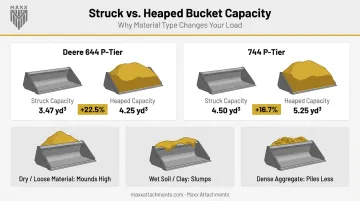
The gap between struck and heaped capacity varies more than most spec sheets suggest. John Deere's own P-Tier documentation shows the 644 P-Tier at 3.47 cubic yards struck versus 4.25 cubic yards heaped, roughly a 22.5% increase.
The 744 P-Tier spec sheet lists a smaller gap, around 16.7% (4.50 struck vs. 5.25 heaped). There's no single universal percentage; it depends on bucket profile and model.
Material type changes the practical heap too:
- Dry, loose material (hay, mulch, wood chips) heaps generously and holds its shape
- Wet soil or clay tends to slump, reducing effective heap volume
- Dense aggregate (crushed stone, ore) piles less due to weight and particle shape
Bucket Size vs. Loader Classification
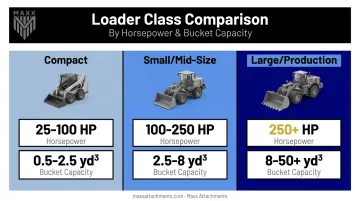
Manufacturers group wheel loaders into classes (compact, small/mid-size, and large/production) using horsepower, operating weight, and bucket capacity together. But these class boundaries aren't standardized across brands. Caterpillar's compact line tops out under 75 hp, while Komatsu's mid-size class starts around 126 hp with meaningful overlap between categories. Treat these classes as lineup descriptors, not hard engineering thresholds.
Range of Wheel Loader Bucket Sizes by Machine Class
Bucket size ranges are governed by engine power, operating weight, and hydraulic breakout force. Push past the recommended range for a given machine, and you risk instability or a bucket that never reaches capacity on dense material.
Compact Wheel Loaders
Compact loaders run roughly 25-100 HP with bucket capacities from about 0.5 to 2.5 cubic yards. Reference models:
- Bobcat L65: 55 hp, 0.875 cubic yards
- Bobcat L95: 74 hp, 1.2 cubic yards
- Cat 906-908 series: 74.7-75.1 hp, 1.0-2.0 cubic yards
These machines fit tight urban sites, landscaping, and light material handling where maneuverability matters more than raw volume.
Small to Mid-Size Wheel Loaders
This class spans roughly 100-250 HP, with bucket capacities from about 2.5 to 8 cubic yards (some models reach higher depending on configuration). Reference models:
- Cat 950: 3.3-13 cubic yards across bucket options
- Deere 644 P-Tier: 4.0-5.0 cubic yards
- Deere 724 P-Tier: 4.0-5.0 cubic yards
Always verify current spec sheets before quoting a number — configurations change between model years and options.
Large and Production Wheel Loaders
Large and mining-class loaders exceed 250 HP and carry buckets from roughly 8 to 50+ cubic yards.
| Model | Power | Bucket Capacity |
|---|---|---|
| Cat 990 | 786 hp | 11.25-13 yd³ |
| Cat 992 | 900 hp | 15-32 yd³ |
| Cat 995 | 1,847 hp | 22.3-57 yd³ |
| Komatsu WE1850 | 2,000 hp | 40-43 yd³ |
| Komatsu WE2350 | 2,300 hp | up to 70 yd³ (super-high-lift coal) |
Notice these are always ranges, not single numbers. That's because the same loader model can be fitted with multiple bucket widths and profiles depending on whether it's handling standard rock, coal, or high-density ore.
Factors That Determine the Right Bucket Size for Your Application
Picking the right bucket is a balancing act. More volume per pass boosts productivity, but only up to the point where you overload the hydraulics or tip the machine forward.
Material density drives this more than anything else. Crushed stone and ore weigh far more per cubic yard than hay, mulch, or snow, so:
- Dense materials require smaller buckets to stay within rated operating capacity
- Light materials allow larger buckets without exceeding weight limits
- Mixed-density loads need a mid-range bucket sized to the heaviest material in the mix
Tipping load and static stability set the hard ceiling. Caterpillar defines full-turn static tipping load as the material weight that would tip a fully articulated loader with arms level.
It recommends keeping actual bucket payload at or below 50% of that rated tipping load. Counterweights and tire selection can shift this limit slightly, but they don't eliminate it.
Site and application constraints matter just as much:
- Narrow site access or tight turning radius often forces a smaller bucket regardless of what the machine could technically carry
- Specialty tasks such as snow clearing, feedbunk cleaning, or stockpiling often call for a specific bucket profile over a larger general-purpose one
- Overhead clearance limits in barns or loading docks can restrict bucket height and rollback angle
Attachment condition affects real-world capacity too. As a bucket wears, edge and floor erosion change how it fills and how much material it actually holds per pass.
Heavy-duty cutting edges and reinforced floor plates slow this wear, keeping actual capacity closer to the rated volume over the bucket's service life.
Before buying, cross-check your selected bucket's rated capacity against the loader's OEM operating capacity. Skipping this step is how warranty claims get denied.
How Bucket Capacity Is Measured and Verified
OEM spec sheets list rated heaped capacity based on standardized testing methods: SAE J742 for most North American loaders, ISO 7546 for some compact Cat models. These published figures, not vendor estimates, should be your reference point when comparing buckets.
For older or modified buckets without current documentation, a manual cross-sectional-area method works as an estimate:
- Trace the bucket's profile from the side
- Divide the traced area into grid sections
- Calculate each section's area
- Multiply the total cross-sectional area by bucket width
This won't match lab precision, but it gets you close enough to sanity-check a listed capacity.
Field-measured capacity can differ from spec-sheet numbers due to:
- Wear on the cutting edge and side plates
- Bent or repaired structural components
- Unusual heap angles from non-standard materials
Risks of Choosing the Wrong Bucket Size
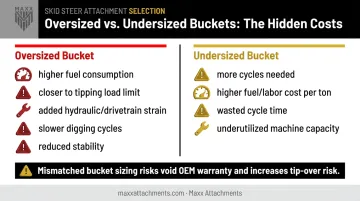
Oversized buckets create more problems than they solve. They increase fuel consumption, push the machine closer to its tipping load limit, and add strain to the boom, hydraulics, and drivetrain over time.
A ForConstructionPros report on wheel loader bucket selection notes that an oversized bucket can slow digging cycles and reduce stability, the opposite of what buyers expect from going bigger.
Undersized buckets hurt productivity a different way. Every pass moves less material, which means more cycles to finish the same job. More cycles mean more fuel burned, more labor hours, and higher cost per ton moved — even though the machine itself is running well within its limits.
Beyond productivity losses, a mismatched bucket-to-loader combination carries warranty and safety risk too. It can void OEM warranty coverage on the hydraulic system or structural components, and raises long-term risk of tip-overs or structural fatigue, especially on sites with uneven grades or frequent full-bucket lifts.
Frequently Asked Questions
What is the capacity of a wheel loader bucket?
Capacity ranges from under 1 cubic yard on compact loaders to over 50 cubic yards on the largest production and mining loaders. It's expressed as heaped capacity, following SAE-based rating standards.
What is the bucket capacity of the 950 wheel loader?
The current Cat 950 lists a bucket range of 3.3 to 13 cubic yards, placing it in the medium wheel loader class. Configuration and bucket profile determine where in that range a specific unit falls.
What is the bucket capacity of a 744 wheel loader?
The John Deere 744 P-Tier lists a bucket range of roughly 5.0 to 5.85 cubic yards. Deere currently classifies this model as a large wheel loader, not mid-size.
What's the difference between struck and heaped bucket capacity?
Struck capacity is the level-full volume with no material above the rim. Heaped capacity adds the pile above the rim and is the figure published on manufacturer spec sheets.
How do I know if a bucket is too big for my wheel loader?
If the loaded bucket's material weight approaches or exceeds the machine's rated tipping load or operating capacity, the bucket is oversized. Check the loader's rated payload before assuming a bigger bucket is better.
Can I replace a worn wheel loader bucket with a heavy-duty aftermarket option?
Yes. Heavy-duty replacement buckets engineered for extended service life can restore or improve performance compared to a worn factory bucket, provided the replacement is rated correctly for your machine's tipping load.